Within the U.S. defense ecosystem, the fight to protect classified data is increasingly won or lost at the endpoint, across laptops, field devices, mobile platforms, and IoT systems.
As adversaries develop increasingly sophisticated tools to compromise those endpoints, protecting defense data has become an operational imperative. The recent Chinese breach of a state-linked cybersecurity firm illustrates just how advanced and global these threats have become and why the U.S. defense community must reexamine how it safeguards data at the device level.
The New Battleground for Classified Data
In the defense sector, an endpoint is any device tactical or administrative that connects to a mission network or stores sensitive data. These range from command center workstations to field tablets, ruggedized laptops in logistics hubs, and even embedded IoT sensors in defense infrastructure.
Three factors make endpoint protection critical:
- Data resides at the point of use, where a single compromise can expose operational intelligence.
- The attack surface continues to expand as contractor laptops, mobile units, and unmanaged endpoints proliferate.
- Data is constantly moving between classified environments and endpoints, creating ongoing opportunities for exfiltration.
As mission data increasingly resides on endpoints, data at rest protection is a foundational requirement for securing classified and sensitive defense information.
What the Breach Signals for U.S. Defense Security
In November 2025, a Chinese cybersecurity firm was breached, exposing over 12,000 classified documents and an arsenal of offensive tools designed to compromise endpoints worldwide.
The breach revealed:
- Broad, cross-platform attack capability across Windows, macOS, Linux, iOS, and Android devices.
- Confirmed hardware-level espionage, including a malicious power bank used to extract data from connected systems.
- Large-scale data exfiltration, with terabytes of government and telecommunications data stolen from multiple countries.
Why it Matters to the U.S. Defense Community
These revelations underscore several urgent realities for defense teams:
- The breach shows adversaries possess cross-platform, persistent access capabilities designed precisely for such environments.
- Devices used in defense settings including chargers, cables, USBs, could now be compromised delivery systems.
- China’s dual role as a major hardware manufacturer and state cyber actor raises the risk that endpoint components themselves may be pre-compromised before reaching U.S. networks.
In the defense community, endpoint compromise doesn’t just threaten data, it threatens operational readiness, human safety, and strategic advantage.
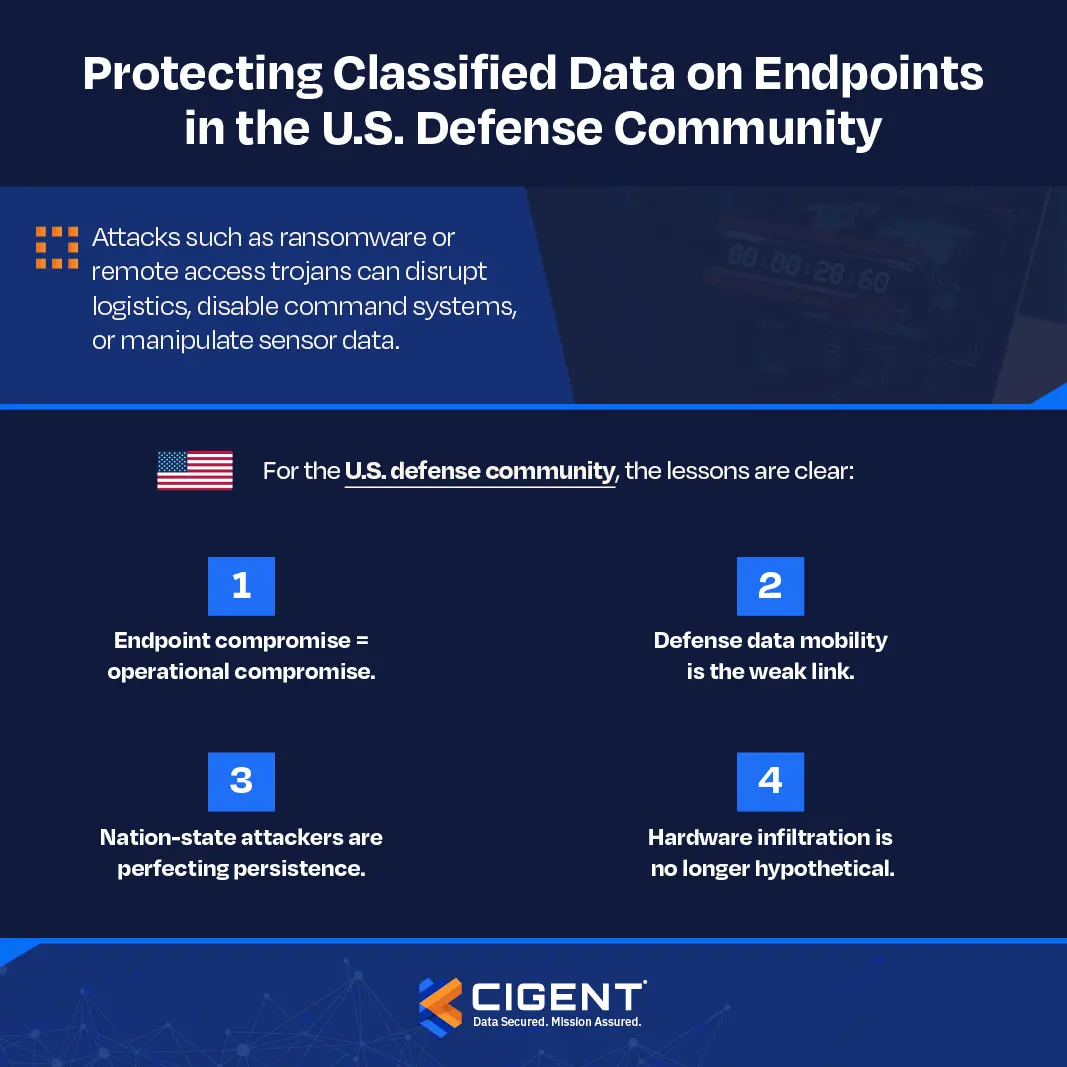
When endpoints are compromised, attacks such as ransomware or remote access trojans can disrupt logistics, disable command systems, or manipulate sensor data. Persistent endpoint access allows adversaries to quietly siphon classified research, weapon system telemetry, or contractor schematics, eroding decades of innovation and billions in defense investment. This reality is why the National Security Agency established CSfC requirements and why CSfC-aligned data at rest protection is now essential for systems handling classified workloads.
The Evolving Threat Environment
The Chinese reflects a broader trend: nation-states are industrializing endpoint compromise. Adversaries are now deploying AI-assisted reconnaissance, multi-OS zero-day exploitation, and supply-chain infiltration at unprecedented scale.
For the U.S. defense community, this means adversaries can:
- Compromise contractor endpoints as indirect access into classified systems.
- Deploy sleeper implants on hardware awaiting activation.
- Exfiltrate mission data in real time through encrypted tunnels.
- Operate below the radar of traditional network monitoring tools.
As a result, endpoint protection has become synonymous with national defense.
Best Practices: Securing Classified Data on Endpoints
No defense organization can eliminate cyber risk entirely, but disciplined, layered controls at the endpoint can dramatically reduce exposure. As adversaries increasingly target devices rather than networks, endpoint protection must be treated as a core element of operational security, not a secondary IT function. The following best practices represent the highest impact actions defense organizations and contractors can take to protect classified and mission data at the edge.
- Encrypt everything
Software full drive encryption should be mandatory across all classified and sensitive endpoints. Encryption neutralizes data theft from lost or stolen devices.
- Deploy EDR and DLP at scale
Modern Endpoint Detection and Response (EDR) and Data Loss Prevention (DLP) tools must be standard on all defense systems. These tools monitor endpoint activity, block unauthorized data transfers, and detect anomalies early.
- Tighten hardware supply chains
Vet all hardware vendors. Ban unapproved chargers, storage devices, and power accessories. Establish tamper-evident controls and hardware validation at the procurement stage.
- Implement Zero Trust principles
Assume every endpoint, contractor or agency-owned, could be compromised. Require continuous authentication, device health checks, and micro-segmentation to prevent lateral movement.
- Automate patching and visibility
Outdated endpoints are prime targets. Automate patch management and ensure real-time visibility into device health, configuration, and activity logs across all tiers of the defense ecosystem.
- Harden remote operations
For remote or field operations, enforce VPN-only access, device compliance checks, and endpoint lockdown modes. No unmonitored device should process or store classified material.
Lessons for Defense Cybersecurity
The incident is a case study in what can happen when endpoint data protection fails even within a cybersecurity organization. For the U.S. defense community, the lessons are clear:
- Endpoint compromise = operational compromise.
- Hardware infiltration is no longer hypothetical.
- Nation-state attackers are perfecting persistence
- Defense data mobility is the weak link.
The Path Forward
To secure classified data, the Department of Defense and its industrial partners must move beyond reactive endpoint management and adopt proactive, intelligence driven protection. It also means establishing endpoint specific incident response playbooks that include rapid device isolation, forensic imaging, and classified data sanitization. Finally, organizations must enforce real time compliance verification.
Schedule a personalized demo and see how our solutions integrate into your environment to secure data at rest, strengthen compliance, and simplify operations.
Ryan Matthews
Ryan Matthews is a cybersecurity professional with more than 12 years of experience supporting U.S. government and defense agencies. His background includes developing and implementing secure data-at-rest and endpoint protection strategies for mission-critical environments. At Cigent, Ryan provides insights into evolving cyber threats, compliance frameworks, and practical defense measures to protect sensitive information across federal and enterprise networks.