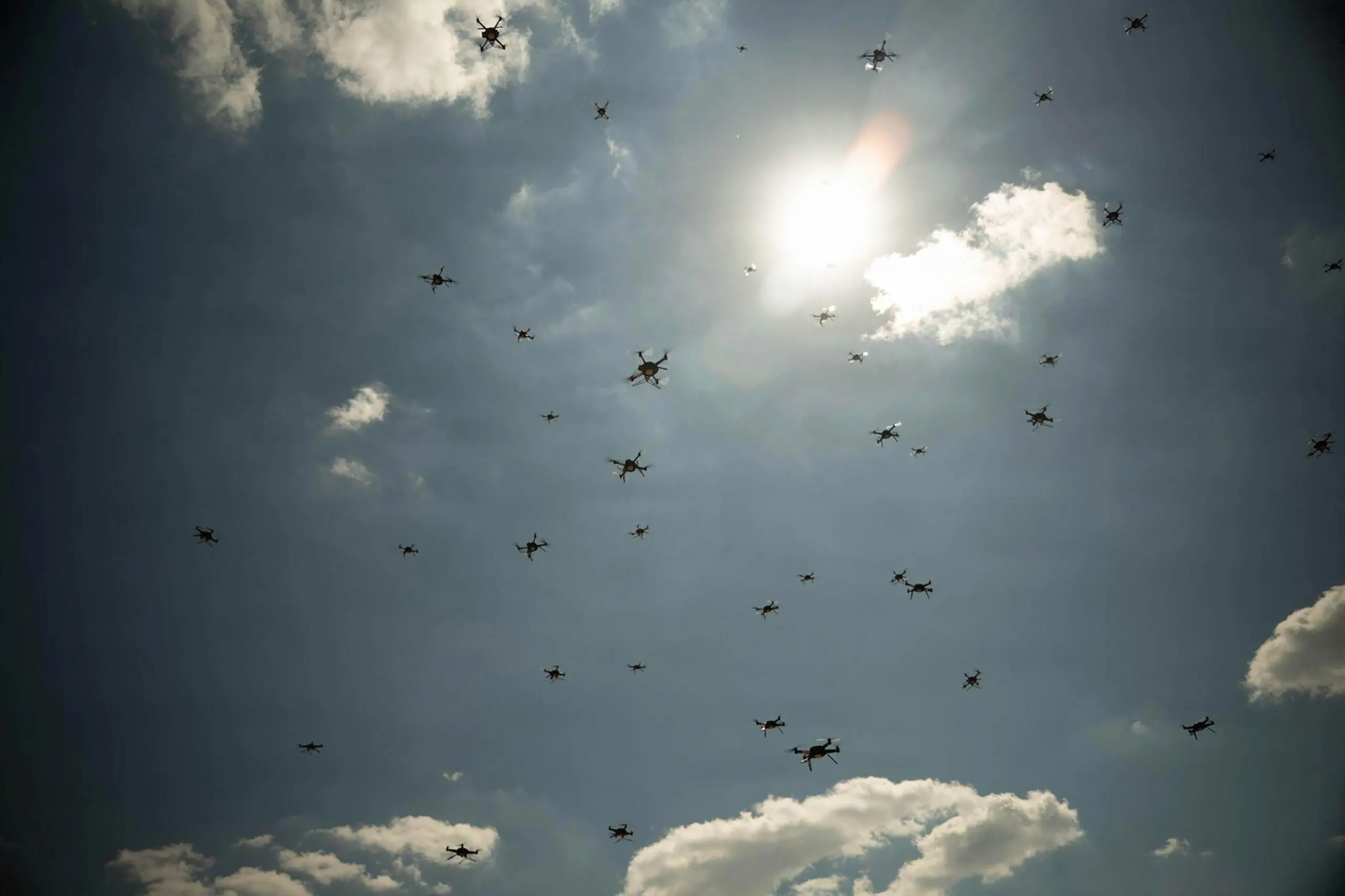
Classified information is increasingly leaving the data center. It now resides on laptops, tactical servers, weapon systems, unmanned platforms, mission computers, sensors, vehicles, and edge-computing devices operating in environments where physical control cannot always be guaranteed.
That creates a basic national-security question: If an adversary gets the device, do they also get the data?
Protecting information against that scenario is the purpose of Data-at-Rest (DAR) protection. For organizations supporting the Department of War and the defense industrial base, understanding DAR is increasingly important as computing moves toward the tactical edge, artificial intelligence becomes embedded in mission systems, and classified information is stored on a growing variety of endpoints. The technology can become complicated. The basic concepts do not have to be.
What Is Data at Rest?
Information generally exists in one of several states. When information is traveling across a network, it is commonly called data in transit. When an application or processor is actively working with information, it may be described as data in use. When information is stored on a device or storage medium, it is data at rest. Think of a classified mission plan. When the plan is transmitted from one location to another, it is data in transit. When it is saved onto a laptop’s SSD, it becomes data at rest. The important point is that turning the laptop off does not remove the information. The mission plan remains stored on the drive. If someone obtains that laptop or simply removes its SSD, the data may still be there. DAR protection is intended to make that stored information inaccessible to someone who is not authorized to retrieve it.
Where Does Data at Rest Live?
The obvious answer is computers, but the real answer is considerably broader. Any system containing persistent storage can potentially retain sensitive information.
Across defense and National Security Systems, DAR can reside on:
- laptops and desktop computers;
- tactical and ruggedized computers;
- SSDs and other internal storage;
- tactical and edge servers;
- command-and-control systems;
- weapon and fire-control systems;
- aircraft and aircraft mission computers;
- ships, submarines, and maritime systems;
- ground vehicles;
- unmanned air, ground, surface, and undersea systems;
- intelligence and ISR platforms;
- sensors and sensor-processing systems;
- mission-planning workstations;
- maintenance and diagnostic equipment;
- ground-control stations;
- portable SSDs and removable storage; and
- other embedded computing platforms.
A useful rule is, if the system remembers something after the power is turned off, it probably contains Data at Rest. That matters because many of these systems operate outside highly controlled facilities. They travel. They deploy. They fail. They crash. They are abandoned. And in conflict, some will inevitably be captured.
What Kind of Defense Data Is at Risk?
When people hear “classified data,” they often imagine documents stored in folders. Modern mission systems retain much more than documents.
Depending upon the platform and mission, DAR may include:
- Mission information: operational plans, target packages, coordinates, waypoints, routes, tasking, and mission histories.
- ISR information: imagery, video, radar, sonar, acoustic information, geospatial data, sensor collections, and intelligence products.
- Communications information: network configurations, addresses, communications parameters, credentials, and information about tactical data links.
- Electronic warfare information: threat libraries, signatures, EW parameters, and information about friendly and adversary capabilities.
- System information: software, firmware, configurations, logs, maintenance information, and diagnostic data that may reveal capabilities or vulnerabilities.
- AI and autonomy information: trained models, algorithms, sensor-fusion information, mission datasets, and software supporting recognition, targeting, navigation, decision support, or autonomous behavior.
One captured device can therefore reveal far more than the information visible on its screen. It may tell an adversary where forces have been, what they have observed, how they communicate, what they can detect, how their systems operate, and potentially what they intend to do next.
Why Physical Possession Changes the Security Problem
Most people think about cybersecurity as keeping an attacker out of a computer. DAR protection deals with a different scenario:
The attacker already has the computer. Imagine a tactical endpoint is captured and transported to a sophisticated nation-state exploitation laboratory. The adversary now has physical possession of the motherboard, processor, firmware, storage, operating system, security hardware, everything. They can remove the SSD. They can disassemble the equipment. They can connect components to specialized forensic tools. They can purchase identical systems and experiment on them. And they may have teams of hardware engineers, firmware experts, reverse engineers, intelligence analysts, and cryptographers with weeks or months to attack the system. The question is no longer: “Can the attacker get through our firewall?” It becomes: “With our device sitting on their laboratory bench, can they get to our data?” That is the problem DAR architecture must solve.
Encryption Is the Foundation, but Encryption Alone Isn’t the Architecture
DAR protection starts with encryption. Encryption transforms readable information, or plaintext, into unreadable ciphertext using a cryptographic key.
A simple metaphor is a safe. The data goes into the safe. Encryption creates the strong walls around it. The cryptographic key provides the ability to open it.
Modern cryptographic algorithms such as AES can provide extremely strong protection when properly implemented. But this leads to an important misunderstanding. A sophisticated attacker generally does not need to “break AES” if there is an easier way into the safe.
They can ask:
- Where is the key?
- What protects it?
- What causes the storage to unlock?
- Does the computer unlock it automatically?
- Can the authentication process be bypassed?
- Can firmware be manipulated?
- Can the boot process be compromised?
- Does defeating one component expose everything?
The strongest safe in the world isn’t very useful if the key is taped to the door. For classified information, DAR protection therefore has to consider the entire architecture surrounding the cryptography.
What Is a Self-Encrypting Drive?
A Self-Encrypting Drive (SED) is an SSD or other storage device that performs encryption within the drive itself. Rather than relying entirely on the operating system to encrypt information, the storage device contains its own cryptographic Encryption Engine (EE). That creates a valuable hardware security boundary. When properly implemented, data written to the storage media is encrypted by the drive. Removing the SSD and plugging it into another computer should not reveal the protected information.
Hardware-based encryption can therefore provide important advantages for high-assurance environments because a critical protection mechanism resides within the storage device rather than exclusively in the host operating system. But there is an important catch. An encrypted drive still needs a secure way to decide who is allowed to unlock it.
EE and AA: The Safe and the Lock
This is one of the most important concepts in classified DAR protection. NSA’s CSfC component framework for Hardware Full Drive Encryption distinguishes between two important functions: Encryption Engine (EE): the mechanism that cryptographically protects the information. Authorization Acquisition (AA): the mechanism responsible for obtaining the authorization needed before protected storage can be accessed. NSA’s current Components List explicitly notes that hardware full-drive-encryption products evaluated for only AA or only EE must be paired appropriately so that both functions are met.
The easiest way to understand the difference is with a safe. The EE is the safe. Imagine a massive steel safe with walls that are extraordinarily difficult to penetrate. That’s the encryption engine. AA is the lock on the door. The lock determines whether someone is actually authorized to open the safe.
Without a meaningful lock, the strength of the safe becomes far less important. A SED that provides powerful hardware encryption but effectively unlocks as part of the normal startup process can be compared to: A million-dollar safe whose door automatically opens when someone turns on the lights. An attacker doesn’t need to cut through the steel walls. They attack the mechanism that opens the door. This is why a SED by itself should not be confused with a complete high-assurance DAR solution. Encryption protects the contents. Authorization controls access to them. For effective protection, you need both the safe and the lock.
What Is NSA’s CSfC Program?
For classified National Security Systems, the National Security Agency provides an architecture for using commercial technology through its Commercial Solutions for Classified (CSfC) program. NSA describes CSfC as a program that enables commercial products to be used in layered solutions to protect classified NSS information. Rather than simply approving individual products and telling customers to use them however they want, NSA publishes solution-level specifications called Capability Packages. One of those is the Data-at-Rest Capability Package.
As of August 2026, NSA’s current approved DAR Capability Package is Version 5.1.0, dated March 2026. NSA says the package includes multiple DAR solution designs and guidance covering areas such as software full-disk encryption, virtualization, location-based restrictions, High Assurance GOTS environments, and expanded multifactor-authentication use cases.
The important concept for a non-technical audience is this: CSfC isn’t simply an approved encryption product. It is an approved approach to building a complete security solution.
Think Architecture, Not Product
Imagine building a secure government facility. You wouldn’t evaluate its security by asking: “Does it have a good lock?” You would look at the complete architecture: Are there fences? How many barriers must someone cross? Who controls the doors? How are credentials issued? Is there a guard? What happens if one security system fails? Where is the vault? What protects the vault key? CSfC applies a similar philosophy to cybersecurity.
NSA’s Capability Packages provide product-neutral guidance allowing customers and integrators to select appropriate commercial components and configure them in prescribed ways to create an architecture meeting defined security requirements.
Among the central ideas are:
- Layered protection. Classified information should not depend entirely on one security boundary.
- Evaluated components. Commercial components are evaluated for defined security functions and used in appropriate roles.
- Independence. Multiple protections should reduce the danger that one vulnerability defeats the entire solution.
- Authentication and authorization. Having encryption isn’t sufficient if unauthorized users can easily cause storage to unlock.
- Key protection. The cryptographic keys and mechanisms controlling them must themselves be protected.
- Correct configuration. An evaluated product used incorrectly isn’t necessarily equivalent to the evaluated solution.
This is why NSA says CSfC is founded on the principle that properly configured, layered solutions can provide adequate protection for classified information.
What is difference between FIPS Validation and Commercial Solution for Classified (CSfC) Data Protection
A critical distinction is often lost in discussions about protecting classified data at rest: FIPS and NSA’s Commercial Solutions for Classified (CSfC) program are not interchangeable security standards.
FIPS 140 establishes requirements for cryptographic modules. A FIPS-validated SSD demonstrates that specified cryptographic functionality has been tested against that standard. It does not establish that the drive, by itself, is approved or architected to protect classified data. FIPS validation addresses the cryptographic module; it does not provide the complete security architecture required to protect classified information on an endpoint.
CSfC, by contrast, is a solution-level approach. NSA’s CSfC Data-at-Rest capability uses an architecture combining approved components, cryptographic protections, authentication, key management, and other security controls to address the threats associated with protecting classified information. Components used within an approved CSfC solution must satisfy the requirements applicable to their component type and the overall architecture; the relevant assurance therefore cannot be reduced to whether an individual SSD carries a FIPS label.
This distinction has significant operational consequences. A standalone FIPS-validated drive does not, merely by virtue of its FIPS validation, meet NSA’s architectural requirements for protecting classified data at rest. Substituting a FIPS drive for the required CSfC architecture confuses validation of a cryptographic component with validation of a complete classified-data protection solution.
The gap becomes especially serious when an adversary gains physical control of an endpoint. If a FIPS-encrypted drive is deployed without the authentication and access-control protections necessary to prevent continued access after capture, encryption alone does not protect data that is already accessible through the operating device. In that condition, possession of the endpoint can effectively become possession of the data. The fact that the underlying storage encryption is FIPS validated does not prevent an adversary from accessing data through an already authenticated or otherwise accessible system.
That creates a potentially dangerous false sense of security. An organization can purchase an expensive FIPS-validated SSD, install it in a system containing classified information, and believe that the “encrypted drive” has addressed the data-at-rest risk. It has not necessarily done so. The organization may have purchased validated cryptography without implementing the architecture necessary to protect classified information under the physical-capture scenario that matters most.
The distinction should therefore be explicit: FIPS is a cryptographic validation standard; CSfC is an NSA framework for constructing solutions capable of protecting classified information. A FIPS drive is not a substitute for a CSfC-compliant data-at-rest architecture, and a FIPS drive deployed without effective authentication protections can fail to protect accessible data once an adversary gains physical control of the device.
How Is CSfC Different From BitLocker?
Microsoft BitLocker is a useful example because it is familiar and widely deployed.
BitLocker is a commercial full-disk-encryption technology. Microsoft documents a cryptographic hierarchy in which data is encrypted with a Full Volume Encryption Key, that key is protected by a Volume Master Key, and the Volume Master Key is protected through mechanisms such as TPM-based key protectors and authentication options. Properly configured, BitLocker can provide enterprise data protection.
Commercial encryption generally solves the problem within the architecture and configuration selected by the commercial customer.
CSfC starts with a different threat and assurance model: protecting classified NSS data through a prescribed, layered solution using appropriately evaluated components. NSA’s CSfC program specifically exists to enable commercial products to be used within those layered architectures.
This distinction is important because commercial technology itself is not the enemy. In fact, CSfC deliberately uses commercial technology. The difference is how that technology has been evaluated, combined, configured, and deployed. A commercially available product may potentially serve as part of an approved architecture when it satisfies the applicable requirements. But a commercial product deployed in an ordinary commercial configuration does not become a CSfC solution merely because it uses strong encryption.
FIPS vs. Commercial Encryption vs. CSfC DAR
|
Commercial Encryption |
FIPS Validation |
CSfC DAR |
| Primary question |
Can I encrypt this data? |
Does the cryptographic module meet defined requirements? |
Does the complete architecture appropriately protect classified DAR? |
| Focus |
Product/function |
Cryptographic module |
Complete solution architecture |
| Typical use |
Enterprise data protection |
Government/commercial cryptographic assurance |
Classified NSS information |
| Strong encryption |
Often |
Yes, within validated scope |
Required as part of the solution |
| Authentication considered |
Depends on product/configuration |
Within applicable module scope |
Yes, as required by architecture |
| Layered protection |
Not necessarily |
Not its primary purpose |
Core architectural principle |
| Evaluated components |
Varies |
Cryptographic module validated |
Components evaluated for applicable CSfC roles |
| Enough by itself for classified DAR? |
No |
No |
When properly implemented and approved for the applicable mission, this is the architecture designed for that purpose |
Why Layering Matters
Why go through all this complexity instead of simply using one very strong encryption product? Because no technology should be assumed to be perfect.
For classified data facing sophisticated adversaries, the goal is to prevent one vulnerability or one compromised mechanism from automatically becoming a complete data compromise.
DAR Protection Is Especially Important at the Tactical Edge
The DAR problem is becoming more important because classified information is increasingly moving away from highly protected facilities.
Edge computing, AI, distributed operations, advanced sensors, unmanned systems, autonomous systems, modern weapons, and mobile command-and-control capabilities all place more computing and storage into physically vulnerable environments. Internal Cigent materials similarly identify tactical edge systems, vehicle systems, autonomous platforms, deployable kits, forward servers, disconnected operations, and mission devices as environments where NSS DAR exposure requires attention.
A tactical endpoint may also operate completely disconnected from enterprise infrastructure. There may be no network connection.
There may be no cloud security service. Remote wipe may not work. Administrators may have no ability to reach the device.
That creates another important principle: At the tactical edge, protection has to travel with the data. The endpoint must remain capable of protecting its stored information even when every friendly network connection is gone.
Five Questions Every Program Should Ask
The technical details can be left to security architects, engineers, and integrators. But program managers, acquisition professionals, executives, and system owners can begin with five straightforward questions:
- What classified or mission-critical information does this system retain?
- Where is that information physically stored?
- What happens to it if we lose physical control of the device?
- What must an adversary defeat before the storage becomes accessible?
- Does the protection architecture meet the applicable NSA requirements for the classified information and mission?
Those questions should be asked during requirements development and system architecture, not after an endpoint has already been fielded.
Data-at-Rest protection answers one of the simplest and most consequential questions in modern defense cybersecurity: If we lose the device, do we lose control of the data? Encryption is the foundation of the answer. But for classified information, the complete answer includes much more. A self-encrypting drive can provide a powerful Encryption Engine, but the safe still needs a lock—which is why Authorization Acquisition matters. FIPS validation provides important assurance regarding cryptographic modules, but a FIPS-validated drive alone is not a complete classified DAR architecture.
Commercial technologies such as BitLocker can provide excellent encryption, but enabling commercial full-disk encryption by itself isn’t equivalent to implementing an NSA-defined CSfC solution. NSA’s Commercial Solutions for Classified Data-at-Rest program brings these concepts together into a layered architecture specifically intended to protect classified NSS information using appropriately evaluated commercial technologies.
The simplest way to remember all of this is:
Encryption builds the safe.
The EE protects what’s inside.
AA controls the lock.
FIPS helps validate critical cryptographic machinery.
CSfC defines how the security system fits together to protect classified information. And at the tactical edge, where laptops, servers, vehicles, sensors, weapons, and unmanned platforms may eventually fall outside friendly physical control—the ultimate objective is straightforward: Losing the device should never automatically mean losing the classified data stored inside it.
Kelvin Quezada
Kelvin Quezada is a Product Marketing Manager at Cigent, where he leads strategy, positioning, and go-to-market efforts for the company’s Data-at-Rest protection solutions. With more than a decade of experience across cybersecurity deployments, product marketing, and technical enablement, he translates complex technical concepts into clear, mission-focused value for defense programs.